Pages

Wednesday, 30 September 2015

The Wild Swans by Jackie Morris

review  by Maryom 

About eighteen months ago, writer and artist Jackie Morris and publishers Frances Lincoln came together to produce a little gem of a book East of the Sun, West of the Moon 
beautifully written, exquisitely illustrated, bringing new life to an old folk tale in a format designed to appeal to both old and young. All it lacked was a companion or two. Now it has one - a re-telling of Hans Christian Anderson's The Wild Swans.
It's a tale familiar from childhood; eleven princes are turned into swans by their step-mother, and their sister, Eliza,  is the only one who can rescue them. Folk tale curses and enchantments are usually lifted by someone having to undertake a daunting, possibly life-risking, task or journey; here the task is maybe not so dangerous, but certainly very painful - Eliza must gather, thresh and spin nettles (bare-hand and footed) and then knit shirts from the thread, while never speaking a word to anyone! As Eliza goes about her task, more obstacles hinder her; sometimes people believing they're taking care of her, sometimes people wishing her harm. In the author's own words "It is a story about love, endurance, magic, silence and communication, misunderstandings, mistakes, courage". And it proves that the feisty young heroine isn't just an invention of modern fiction.

These books are perfect for those of us who, while still enthralled by folk or fairy tales, feel ourselves a little too old for 'children's books'. At 173 pages the story is longer than the brief version offered to small children, giving time for characters to be developed beyond the stereotypical doting sister, cursed prince or evil step-mother. Jackie Morris' illustrations are, as always, a delight - a fairy-tale world evoked in watercolours, and reproduced in several double-page spreads and smaller gems scattered among the text. This is above all a book that feels special, with attention to the little details so often skimped on - heavy pages, 'proper' binding, the title embossed on the slip-cover; a true gift of a book.


 See Jackie Morris reading from The Wild Swans here on You Tube

 Publisher - Frances Lincoln
Genre -
folk tale, age? almost any!


Tuesday, 29 September 2015

The Zoo by Jamie Mollart

review by Maryom


James Marlowe was an ad man at the top of his game, able to target the demographic, spin a warm, caring, desirable image for his customers, twist a few facts if necessary and SELL just about anything. Focusing on winning the next high-revenue contract, celebrating long and hard when he did, fuelling his lifestyle with drink and drugs, ignoring the  - all started to poison his personal relationships and alienate his wife and friends. Now his glorious career is in the past, and he's a shattered man, detained in a psychiatric unit, believing himself at the mercy of a group of plastic figures collectively referred to as The Zoo, trying to piece together how things went so very, very wrong.

 Through one man's crisis, Mollart explores the shallow, cynical world of advertising, giving his protagonist just enough conscience to feel uneasy about his role in promoting an unethical business, but not enough to actually do something about them. He isn't going to turn whistle-blower and spill insider information to the press; instead he bottles his doubts for too long, subduing them with drink and drugs - until they burst out in as messy a way as possible. From the first page, in fact the first sentence, the reader is plunged into the troubled mind of a man struggling to cope, feeling himself tyrannised and controlled by a set of models - in fact it reads rather like the beginning of a horror story. As the story alternates between 'now' in the psychiatric ward, and 'before' as events in James' life start to unwind, it becomes apparent that this is no fantasy horror but one that's very much part of the real world.
At times it's a very troubling story; not only from James' personal perspective (after all he does seem determined on self-destruction) but also by raising questions about the consumerism that makes the modern world go round and the advertising industry that helps it. Throughout the figurines remain enigmatic - sometimes they seem to represent different aspects of James, at others various attributes belonging to family or colleagues - but however you see them, they remain scary, particularly in the influence James grants them.
Especially for a debut novel, this is an absolute stunner! Something - possibly the hallucinations experienced by James, possibly something in the writing style itself  - reminded me of Iain Banks' work, making Jamie Mollart an author I'll definitely be looking out for. I've read some great debuts this year, and this is up there with the best of them.

Maryom's review - 4.5 stars
Publisher - Sandstone Press
Genre - Contemporary Adult Fiction

Monday, 28 September 2015

Candy Gourlay - UKMG Extravaganza - Author Contribution

Candy Gourlay (@candygourlay) is a Filipino author based in London. Her books have been listed for awards such as the Carnegie, the Blue Peter, the Waterstones and the Guardian Children's Book Prize. She blogs on Notes from the Slushpile and on CandyGourlay.com .
With warm thanks to the UKMG Extravaganza Book Tour and  Maryom and The Mole for hosting me on Our Book Reviews!

The other day, I saw a funny Filipino meme doing the rounds on Facebook. The images were so hilarious, I used Photoshop to repurpose the comic into the one on the right.

I was gratified when a librarian from Culford School Library reposted it with the caption:

I promise not to judge your choice of reading matter.

Thanks, Culford School Library - you totally got the message that reading should first and foremost be about pleasure.

You'd think the idea of reading for pleasure is obvious, but it isn't.

WHO CHOOSES THE BOOKS? 

The younger a reader, the less control she has on what she reads. Grown-ups - parents, teachers, librarians - will dictate what books enter her world.

And when it comes to children, grown-ups will always have an agenda ... since printing began, books have been seen as a means to instruct, to teach a moral lesson, to mould the unformed child into a good adult.

(Teenagers are an interesting mixture of independence and adult influence. The emergence of Young Adult fiction as a strong genre comes as no surprise - there is a commercial element to defining age boundaries. The idea of the 'teenager' emerged after the second world war when teenagers became recognised as a consumer demographic with money to spend.)

MIDDLE OF WHAT?

For forever, I've been aware of 'Middle Grade' as a category of children's books for ages eight to twelve. But that's because I come from a country with strong ties to the United States, where the label first emerged.

But MG is a recent arrival to the United Kingdom, prompting irritation from people like Carnegie-winning author Philip Reeve (Mortal Engineswho described the label as a "nonsense".

Reeve wrote: "If you call your books 'middle grade', you are associating them with 'grade', which sounds vaguely educational, and 'middle'. That's 'Middle', as in 'middle England', 'middle class', 'middle of the road','middle of nowhere', 'middlebrow','middling'."

Phew! Strong words (although, as an immigrant, I have always wondered why there is such a negativity attached to being middle class in my poor native Philippines, middle class is what everyone aspires to be).

Personally, I'm happy to embrace the label ... though I agree that the use of the word 'Grade' is problematic in that it suggests children should be reading for educational purposes.

Really, we are not talking about a Middle Grade Reader but a Reader in the Middle.

READER IN THE MIDDLE

Under current legislation, middle schools in England have to 'deem' themselves as either primary or secondary. The 'middles-deemed-primary' is enjoined to stick to a primary-style curriculum. The 'middles-deemed-secondary' is enjoined to follow the approach of a secondary school.

It perfectly captures the conundrum of the Reader in the Middle. Too old for baby books and beginning readers. Too young for the Young Adult free for all.

In fact I have written two books that are being marketed as middle grade, but they occupy opposite ends of the Middle Grade spectrum.

Technically, the first, Tall Story, is written simply enough for a seven-year-old bookworm to cope with. The themes of family and the smattering of magic is ideal for a reader from nine years old up. If Tall Story were a school, it would be a middles-deemed-primary.
Tall Story by Candy Gourlay, Shine by Candy Gourlay

My second book, Shine, is a different matter. The themes are more mature, the writing - with a mysterious storyline sewn into the main narrative -  will be challenging for a middle grade reader who is only just beginning to develop a reading habit. If my first book had not been MG, I suspect it would easily be classified as a teen novel. In any event, if it were a school it would be a middles-deemed-secondary.

PUTTING THE OMG INTO MIDDLE GRADE

My friend Jane McLoughlin (The Crowham Martyrs) came up with a witty label for the more mature end of Middle Grade the other day: OMG, for Older Middle Grade.

I love it because it so aptly captures the surprise and emotional satisfaction of an excellent Middle Grade title.

What makes a book middle grade though? Ahh ... dare I attempt an answer? There is great resistance to attempts to pin down targeted reading ages in children's books.

 In 2008, when publishers floated the idea of age-banding books with labels (5+, 7+, 11+, 13+/teen) there was an uproar.

Philip Pullman led the charge. Here is what he told the Telegraph: "I don't want to see the book itself declaring officially, as if with my approval, that it is for readers of 11 and upwards or whatever. I write books for whoever is interested. When I write a book I don't have an age group in mind."

My own publisher, David Fickling, liked to say: 'Tall Story is not just for children. It's an ALL-READ.' Which was very nice of him. But when people ask me, I say it's for 10 plus. (It's considered Young Adult in the Philippines, but that's another story)

After the Age Banding furore died down, I couldn't help noticing that publishers quietly printed suggested reading ages on the back covers of books anyway. If the reader is not the person with the wallet, I guess it helps to have advice at point-of-sale.

THE WHAT AND THE WHO

When I visit schools though (whether they are middles-deemed-primary or deemed-secondary), what Middle Grade is becomes very, very clear to me.

I see it in the children who loved my books. I see it in the children who found some of it a bit difficult to read. I see it in their enthusiasm for the magical elements in my stories. I see it in the way each child seems to know somebody who is just like their favourite characters. I see it in the way every favourite book a child mentions reflects an aspiration.

In writing Middle Grade, I've learned that you cannot separate out the what from the who, because the Reader in the Middle is what he reads. 

I don't know if the label 'Middle Grade' will be supplanted by some other marketing category. But authors like me would do well to remember that the label means nothing without the reader.

And who is that reader in between?

The Reader in the Middle
The Reader in the Middle is always looking for adventure.
The Reader in the Middle has experienced enough life to identify with social reality, but not enough life to have hindsight.
The Reader in the Middle wants a story in which things happen.
The Reader in the Middle can figure things out for herself but not all the time, so sometimes it's okay to tell as well as show.
The Reader in the Middle has his whole future ahead of him - and he needs hope.
The Reader in the Middle can be anybody she wants to be - and characters will help her achieve that.
The Reader in the Middle wants a story not a lesson.
The Reader in the Middle wants to be the hero of every story.
The Reader in the Middle wants to visit another world.
The Reader in the Middle is growing the reader he is going to be - and we authors in the middle are so lucky to be there with him.

Friday, 25 September 2015

The Machinery by Gerrard Cowan

Review by The Mole

For 10,000 years the life of the Overlanders has been run, almost ruled, by The Machinery. The Machinery, run by The Operator, is an integral part of their lives and it selects their leaders and sets their path. Over the 10,000 years they have slowly expanded to take over the entire Plateau and are on the verge of expansion beyond their shores. But there was a prophecy that The Machinery would break down in the 10,000th year and the One would come and bring ruin with them. It is the 10,000th year and the Strategist Kane has died in mysterious circumstances and a new leader must be selected. Is this an omen or a ploy to demoralise the citizens?

Some years earlier Katrina Paprissi witnessed The Operator, Jandell, - and inventor of The Machinery - kidnap her brother, Alexander, and now -in the 10,000th year someone has set a breadcrumb trail for her to follow that will lead her to her brother.

As I read this book I kept wondering where it was going to go and I feel this spoiled my enjoyment - I had failed to realise that this is part one of a trilogy, in fact I only realised this in the acknowledgements at the end of the book. When you know it's a series then you don't expect the ends to tie up nicely - and here we are left almost on a cliff hanger.

It felt, throughout, that it was going to become a steampunk novel but always just hung in the balance. While The Machinery, and a seemingly complex structure of Strategist, Tacticians and Watchers, rule their lives, the most "advanced" technology they have acquired is cannon - and that was not all their own efforts!

We switched between characters from all sides of the story and Cowan manages to convince us, in his own way, that they are all 'good guys' because everyone seems to do despicable things. The only way to understand which side to root for is to carry on reading the next book in the series - but will we learn then?

Time and again we are introduced to strong confident characters who we can take as an anchor within the plot only to have them portrayed in a more open and vulnerable light.

When we meet Shirka then things start to change rapidly, death and mayhem follow - but not, I stress, at Shirkra's hands - and the previously established order that we have been following, understanding, and becoming embroiled in, suddenly starts to transform completely.

This is going to be a series that must be read in order so now is the time to get started.

A great read that is perhaps more fantasy than anything but may well also appeal to steampunk fans. The second book, The Strategist, comes out in May 2016.

Publisher - Harper Collins (Harper Voyager)
Genre - Fantasy 

Thursday, 24 September 2015

A Slanting of the Sun by Donal Ryan

"An old man looks into the fearful eyes of a burglar left to guard him while his brother is beaten; an Irish priest in a war-torn Syrian town teaches its young men the art of hurling; the driver of a car which crashed, killing a teenage girl, forges a connection with the girl’s mother; a squad of broken friends assemble to take revenge on a rapist; a young man sets off on his morning run, reflecting on the ruins of his relationship, but all is not as it seems"

review by Maryom

Here at last is Donal Ryan's much awaited follow-up to The Spinning Heart and The Thing About December; A Slanting of the Sun, a collection of short stories that he mentioned working on at last year's Edinburgh Book festival and which I've been looking forward to ever since.
Now, there's always a 'thing' about how to go about reviewing a story collection - do you go through each one, giving each as much review space as a novel? Skip through, outlining plots but not dwelling long on each? or treat it as a whole, just name-checking your favourite? I think the publicist's blurb above says all you need to know about the content - so I'm going for the over-view.

First off, it's best to make clear that these aren't the cheeriest of stories; presumably like Tolstoy's families, happy stories are all alike, it's the unhappy ones that have the tale to tell! The mood is generally reflective, and often heart-wringingly sad - so much so that, four or five stories in, I was tweeting about being "wrung out like a dishcloth". For make no mistake, there's an emotional roller-coaster waiting for you inside these pages.

The characters themselves seem, on the outside, to be a pretty normal, almost nondescript, bunch - folk you could pass in the street any day and never remark upon, but, as Atticus Finch says in To Kill A Mocking Bird, "you never really know a man until you stand in his shoes and walk around in them". This is Ryan's gift, to put himself in someone else's shoes, get inside his character's head, and then pull the reader along with him - making us feel the hope, pain, remorse and regret. Happiness, for there is some in among the anguish, generally seems to be confined to some distant past, a golden moment, lit up as the slanting sunbeam illuminates a room, but which faded quickly away, leaving the rest of life feeling dull in comparison.

 The style of telling is quiet and undramatic, like one person quietly chatting to another over a coffee or a pint down the pub - but the tales they have to tell will knock you sideways!

I said I'd mention my favourite - the last, A Slanting of the Sun, which ends on a note of forgiveness and reconciliation.

If you want something fun and light, that will make you laugh out loud - go elsewhere.
If you want a read that will move you, maybe shock you, make you stop and look twice at your neighbours and wonder what makes them 'tick', let you experience emotions that I hope would never befall you in real life, this is the one to choose.


I have a feeling gleaned from fellow-bloggers, than while well known in Eire, Donal Ryan isn't as widely appreciated this side of the Irish Sea - he should be!

Maryom's review - 5 stars
Publisher - Doubleday
Genre- adult, short stories,

Tuesday, 22 September 2015

The Temporary Bride; a memoir of love and food in Iran by Jennifer Klinec

"A relationship was a mathematical formula: the correct variables of age, beauty, morality and finances were entered and the output was a successful, peaceful marriage. It couldn't be, therefore, that their Iranian son could feel desire for someone six years his senior, someone who didn't come to him pure and untouched. I was an amusing visitor from another world and soon enough I should return to it, fading quietly into an anecdote ..."

 review by Maryom

The Temporary Bride is a cross between autobiography, cookbook, traveller's tale and romance; an account of how one Western woman went to Iran looking for traditional recipes and found love.
Jennifer Klinec was born in Canada to Hungarian-Croatian parents, moved to England, spent weekends away from her corporate job in travelling to as many exotic, out-of-the-way places as possible, then gave up that life to set up her own cookery school. Her speciality was the re-creation of unusual but authentic recipes, with nothing altered or tamed down to suit British palates: not the food served in restaurants but that consumed at home.
Eventually this culinary curiosity took Klinec to Iran, where, covered almost head-to-toe, she began to learn the art of Persian cookery in a family kitchen in the city of Vazd. This strange westerner with independent ideas at first repels the son of the household, but slowly he becomes intrigued by this woman who is so very different to the bride imagined for him .... and the couple find themselves falling in love. How can their story have a chance of a happy ending in a country where both law and custom is against them?

Now sometimes autobiographies can be a little dry and lacking in emotion - the events happened too long ago to have any real feeling attached to them or the reader is too aware of how the 'story' will end - not so here! The writing style feels almost like fiction, giving an immediacy to events, and I was lured in by the mouth-watering descriptions of food, the sights and smells of Iranian streets and kitchens, and then fear of
conducting what is essentially an illicit love affair under the watchful eyes of both family and state. Klinec builds the atmosphere with a masterly touch, making the reader feel there in the moment, whether cooking delicious sounding meals, struggling with bureaucracy for a visa extension, or stealing kisses in hidden alleys.
Mixing with families, becoming temporarily part of them, allowed Klinec to experience Iran and its customs from an unusual,intimate, angle. Whether you're interested in cookery, travel or just a plain old-fashioned love story, there's something for all here. I've only one quibble - it would be nice to have recipes for some of the simpler dishes.
 Every page held me fascinated - but did the story end happily? Read it and see.

Maryom's review - 5 stars
Publisher - Virago
Genre -autobiography, travel, cookery,


Monday, 21 September 2015

These Seven - book launch


These Seven - and Sheelagh Gallagher
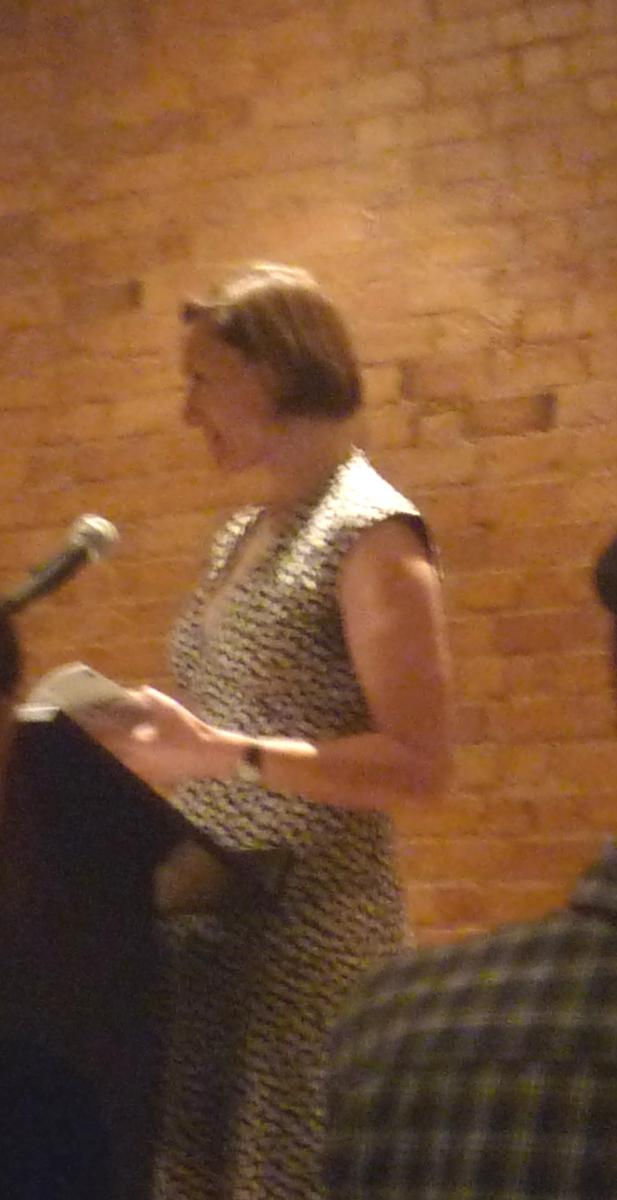
On Saturday evening, Nottingham Waterstones was the scene for a rather unusual book launch - with SIX authors coming together to help promote the short-story collection These Seven.

The stories were commissioned by Nottingham City of Literature, as part of its bid to become a UNESCO city of literature. It's very much a 'home-grown' product; the six new stories are from authors living and writing in the city today, all members of Nottingham Writers Studio, the seventh from the late Alan Sillitoe, probably Nottingham's most famous writer, and the collection is published by Nottingham publisher Five Leaves

David Belbin
After complimentary drinks and nibbles, and a chance to chat to authors we knew and some of the other guests, the evening quickly got down to the serious stuff - readings from the stories.
John Harvey
Brick
Megan Taylor


Paula Rawsthorne
First up was David Belbin reading from Alan Sillitoe's story A Time to Keep, followed by Megan Taylor with Here We Are Again set in Nottingham's Old Market Square, John Harvey with Ask Me Now, a crime story, and Paula Rawsthorne with A Foreign Land, a topical tale about refugees - all read just enough to tempt me to read more. The next author up, Brick, faced a problem - his contribution, Simone the Stylite, is a graphic novel, so not the easiest of forms to read aloud, but he managed well. Alison Moore's Hardanger took us on a dysfunctional family holiday and in Shreya Sen Handley's Nimmi's Wall, a family find something odd at the bottom of their garden.
Afterwards, Sheelagh Gallagher from Bromley House Library in Nottingham talked about how the bid for City of Literature had come about, and of projects for extending reading and writing into all areas of the community from schools and libraries to women's groups, public spaces and prisons.

Shreya Sen Handley
Coming from Nottinghamshire, but having lived in Derby for over 30 years, we're always a little torn between the two cities. This time though, they aren't competing against each other so we're happy to back Nottingham.

Alison Moore

There was time afterwards to buy a copy of the book  - and, of course, get it signed by all six authors while further nibbles and drinks were available. 

Click on the links to read more about the bid for Nottingham to become a UNESCO city of literature, more about the authors themselves, Bromley House Library

Waterstones are very active in promoting authors and their books throughout the country and you can very easily search for what's happening near you through their website.