Pages

Thursday, 27 January 2022

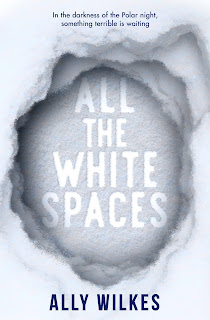
All The White Spaces by Ally Wilkes

Jo was always envious of older brothers Rufus and Francis; the freedom they were allowed while Jo had to stay at home, their shared plans for the future, particularly their intent to join an expedition to Antarctica led by famous explorer, James 'Australis' Randall. When Rufus and Francis are killed during the Great War, Jo resolves to take up their plan and journey south - even if that means stowing away.

As the expedition leaves any signs of civilisation behind, tension aboard the Fortitude increases. Despite his reputation, not everyone totally trusts him, and the weather conditions are not looking good with too much sea-ice for the time of year, but it's once the Ice proper is reached that things start to go really wrong. A fire forces the crew to leave the ship, taking sleds and heading for the base of a rival German expedition, but this is found empty, and seemingly haunted by ghosts which call men out onto the ice and into terrible danger.


Set in the early 20th century period of great Polar exploration, all The White Spaces is a story of self-discovery and -determination set against a backdrop of  icy wastes and encroaching horror. Arctic/Antarctic stories always have some sort of pull over me - the everlasting days of summer, the equally lengthy nights of winter, the necessity for self-reliance and courage against almost over-whelming odds. So naturally I loved this. The ice and its hazards, the gradually shortening days, the complete isolation are all brilliantly captured, and make the reader feel there in this last human outpost.

The horror is finely balanced - not too much left to the imagination, not too self-explanatory (for want of a better word). Maybe it grows from the men, from their deeply hidden fears or desires, or their memories of the horrors of war - maybe it truly is something lurking in that remote place - but the men's reactions to it feel honest and believable. 
It's a story for both readers of historical adventure and horror. From the historical perspective there are similarities with Shackleton's doomed frozen-in-the-ice expedition, whose outcome I half-expected this story to follow (it doesn't). In fiction, an obvious comparison is Dan Simmons' The Terror, and if you loved that, either in book or on TV, you'll love All The White Spaces, but I preferred this as it doesn't take a real-life mystery and add unnecessary 'make-believe' horror. That element is an integral part of All The White Spaces, and the story better balanced for it.


Tuesday, 25 January 2022

Violeta by Isabel Allende


 Violeta del Valle was born in 1920 while the Spanish flu raged outside her parents' house in Santiago, Chile. A hundred years later she lies dying while another pandemic sweeps the world.  In between the two she lives a full, eventful life.  She marries, embarks on a passionate love affair, has children who bring joy and despair, helps her brother rebuild the family fortune, and manages to avoid retribution from both left and right wing of Chile's political extremes.

Told in the first person, at first seeming like a memoir but as it goes on turning into a letter to a grandchild, it should be a fascinating story,  but for me it sadly fell flat. I'm sure I've read Isabel Allende's work before and enjoyed it but it may be that my tastes have changed over the years.  I didn't really feel I knew Violeta, or the multitude of characters that come and go in her life. Maybe the scale was just too sweeping for the length of the book, maybe it was the 'telling, not showing' style of writing, but I certainly wasn't emotionally invested in the outcome. Violeta's life, despite financial and personal losses, seemed to me to be cushioned from the harshness of the world around her, and the terrible realities of Chilean politics. Yet I'm sure this wasn't the author's intent. 


Thursday, 20 January 2022

The Christie Affair by Nina de Gramont


 In December 1926 Agatha Christie disappeared. Her car was found abandoned quite close to her home, but of Agatha there was no trace. A nationwide search followed with hundreds of police and civilians involved but still there were no signs, till eleven days later she was recognised in a Harrogate hotel. Agatha claimed to not remember anything of the intervening time, and the mystery of  her disappearance has intrigued her readers ever since.

Nina de Gramont takes these basic known facts, mixes in some imaginative fiction, and weaves a compelling story around them. Events unfold mainly from the point of view of Archie Christie's mistress, Nan O'Dea, with her fictional backstory of first love and loss taking centre stage, and Agatha's disappearance merely forming the backdrop. It wouldn't be a Christie homage without a murder or two - and a hotel in Harrogate forms the backdrop for a couple of suspicious deaths, treated in typical Christie 'cosy crime' manner. 

Overall it's an enjoyable read, but just a little disappointing in not holding to the few known facts about Agatha Christie's time in Harrogate. Approach it as pure fiction, and it's a much more satisfying story.

Wednesday, 12 January 2022

The Key in the Lock by Beth Underdown


 Ivy Boscawen is in mourning for the loss of her son Tim in the muddy, bloody trenches of the Great War. She can't reconcile herself to his death, take solace in his bravery or the serving of king and country, as confusion surrounds the event. At the same time, she's haunted by another tragic death which occurred years ago, before her marriage, when the grandson of local wealthy powder mill- and  land- owner - Tremain - was killed in a house fire. At the time, Ivy and the boy's father, Edward, acted together to bring about justice as they saw it, but as Ivy winds her way through memories of those awful long ago events, she comes to realise she may have been manipulated herself.


This haunting, atmospheric novel revolves, as you might expect, around 'the Key in the Lock' and, more importantly, who turned it and why. Time may have moved on from the night of the dreadful fire, but, particularly since her own son's death, Ivy is drawn back, going over events time and again, trying to order and rationalise the events of that time. She isn't quite an unreliable narrator but her personal view, her attraction and sympathy for some characters, and dislike of others, inevitably twist her perception of events. As the story unfolds on two timelines, the reader sees Ivy as a young, hopeful, romantic nineteen year old and the contrasting disillusioned middle-aged woman she's grown into. How she ended up so unhappily married is another mystery to unveil.

With its brooding air of mystery and secrets, the story really pulled me in, but overall I thought it was rather sad. There are so many wasted, unfulfilled lives - not just that of young William Tremain dying in the house fire, or Tim and so many others on the battlefield, but also of everyone affected by the lies and deceit spreading out from Tremain's residence.


Saturday, 1 January 2022

Top Ten - and a few more - 2021

It's that time of year, for lists of the good and bad aspects of the last twelve months, so (as I love a Top Ten list) I'm joining in. My list is solely about the GOOD books of the year, though. 
As I started to put it together I realised what an eclectic sort of mix it was - literary, fantasy, sci-fi thriller, a slightly supernatural mystery, a family epic, and even one about lockdown 


Some year's it's hard to pick one book that stands out from the rest. This year it was easy for me. I totally loved Sarah Winman's  Still Life - a story which celebrates life, love, art, beauty, warmth, food, wine and all things Italian. An absolute joy to read.


 My next choice couldn't be more different. Five Minds by Guy Morpuss is a futuristic, dystopian thriller with shades of James Mangold's Identity, in which five personalities live in one body - and one by one they're being killed off. It's a gripping, original debut. 


Fantasy next.  The Witch's Heart by Genevieve Gornichec is a masterful re-imagining of Norse myths, placing a mother and her love for her three very strange children in the forefront of the story. Again, a wonderful debut.


In Lean, Fall, Stand  Jon McGregor takes his 'hero' on a roller coaster ride from the icy wastes of Antarctica, fighting for survival, to hospitals and stroke recovery centres where he faces a very different battle to regain normality and the ability to express himself. I've seen strokes from the outside - watching family members suffer - but McGregor offers a perceptive insight into how the victim themselves must feel in this strange new world


I spent a lot of the first lockdown watching 'pandemic' movies in which scientists battle to save the world from new bugs, or reading the sort of apocalyptic fiction in which a handful of survivors struggle on in isolation. The actual pandemic was very different to either scenario, and it's in that REAL world that Sarah Moss has set The Fell. Kate is an outdoors sort of person, not comfortable to be confined for long, so a fourteen day isolation period is proving tough. Then one late afternoon she decides to sneak up onto the Fell. No one will see her go. She'll meet no one up on the hill. What harm could there be in it?


Time for some humour, and escapist, improbable, action thrown in for good measure. Jonathan Pinnock's long-suffering hero Tom Winscombe is bad in Bad Day in Minsk . Kidnapped, sent under-cover into Belarus, kidnapped again (Belarusan mafia this time), getting caught in a fire fight - it's all become part of a day's work for Tom since he became in the increasingly complex affairs of dead mathematical geniuses the Vavasor twins. I love this series, and I'm glad to hear there are more books on the way.


Inspired by real-life tales of unusual happenings on British lighthouses,  The Lamplighters by Emma Stonex tells the story of three men who mysteriously disappeared from the Maiden lighthouse. The door was found locked from within, dinner laid out on the table, but no sign of the crew. Is there a better place than an isolated lighthouse to set a closed-room mystery?  A brilliant book which engrossed me from the first page.


Another brilliant debut - The Family by Naomi Krupitsky is a story of friendship, family, and Family (the American Mafia). Spanning twenty years, from 1920s to late 40s, it follows the ups and downs of the girls friendship, their lives always entwined with the fortunes of the wider Family. I loved this for its characters, its scale, the writing style which drew me in and hooked me, and the positioning of two young women centre stage in a business dominated by men.


Nick - Michael Farris Smith. Meet Nick Carraway, whose main claim to fame is being the neighbour of Jay Gatsby, and chronicling the summer in which Jay re-discovered his long lost love, Daisy, Nick's cousin. For how much he has to tell about Daisy and Gatsby, it's strange how little we actually know about Nick. This book aims to fill that gap. I'm normally a bit wary of spin-off books but this caught my imagination. 


Threaded with themes about being different, the unpredictability of love, of self-discovery, of the demands art puts on its creators, The Earthspinner  by Anuradha Roy centres around the burning desire to create something of beauty from the most basic substance - clay. As a teenager, Sara was taught pottery by an artist in her home village in India; now studying in the UK, she finds relaxation in its familiar demands and forms. The story moves between India and England, between Sara's teenage years and a period roughly 10 years later, between her story and that of Elango, the master potter. I haven't seen many other bloggers talking about this book but it's worth finding out.


In between these newly released books I took time out to catch up with some old favourites and some sadly neglected books from the to-be-read pile. From among these I'd like to mention a few


Re-visiting Kazuo Ishiguro's The Remains of the Day and Never Let Me Go was a delight. I've read both several times since they were first published and my reactions have changed over the years, my sympathies moving to lie elsewhere. Both were definitely worth catching up with again. 


Just Like You by Nick Hornby was a review book from a few years ago that had been overlooked; I'm not sure why, but I'm glad I DID read it eventually. Broadly speaking it's the story of a very mismatched couple - a young black man and older white women. Can mutual attraction form a basis for a long-term relationship, or do their many differences mean they're doomed to part? Nick Hornby's always good on the relationships but this time there's an added depth with, in various conversations scattered throughout, various characters discuss their feeling about the Brexit vote. It might be a bit dated (I wonder how many opinions would be the same now?) but it offers a rare balanced insight into why people thought and voted as they did.


Sarah Moss gets a second mention in this round up, as years after everyone else I've at last discovered Night Waking. It's a sharply observed account of a mother pulled this way and that by her children, and in fear of losing her 'self' as seen through her academic career. Add in a mystery when a child's body is discovered buried just outside the garden, and I can see why everyone rated it so highly.


Last, but by no means least, in the hiatus between rewatching the first Netflix series of The Witcher and the second one being released, I tracked down my Netgalley copies of The Sword of Destiny and The Lady of the Lake. Much as I love sword and sorcery just for the fantasy aspect, these books move beyond that. It's easy to see echoes of  the 'real' world in the treatment of elves, or the manipulation of women such to gain power. They don'y quite match up to the TV series, and The Lady of the Lake is the last in the series so carries spoilers, but if like me you're now waiting for series 3 or the Blood Origin spin off, indulge your Witcher cravings with a good read.
Friday, 12 November 2021

The Fell by Sarah Moss

It's November 2020, and England is in lockdown (again). Nobody should be out and about unless on absolutely vital business or their permitted daily walk. For Kate and her son Mark things are worse as they are stuck in fourteen day quarantine after coming into contact with Covid. It could be a quiet peaceful time. An opportunity to catch up on all those things you've intended to do - start a sourdough, knit a sweater, write a novel about the pandemic - but Kate has had enough of being cooped up indoors. Even the garden is beginning to feel too constricted. And no one will notice if she slips away up onto the moor for a while, she thinks. But Kate's quick walk goes dreadfully wrong when she slips and injures herself.
At home, Mark grows increasingly worried by his mother's absence, and calling in mountain rescue seems, if possible, to make matters worse by acknowledging the severity of the situation. And meanwhile next door, Alice is trying to accustom herself to living alone since her husband died, feeling cut off from her family (zoom is no way to have dinner together!) but enjoying the luxury of a bed to herself.

Rather oddly I spent a lot of the first lockdown watching 'pandemic' films in which scientists race against time to save humanity, or reading the sort of book in which a small band of survivors struggle bravely on in a post-apocalyptic world, but The Fell is a different sort of 'pandemic' story - one that's more realistic, which tells of something much closer to home, of the feelings of fear, frustration and loneliness that many of us felt. 

Against this familiar backdrop of second (or was it third?) lockdown, the author weaves a story of a woman too restless to stay confined for a moment longer, her son taking life and his mother's presence for granted until the unthinkable happens, their elderly neighbour, lonely and cut off from family, and a man who gives his time freely to help those in trouble. The dullness of lockdown soon changes to tense drama when Kate slips and cannot make her own way home. Will she be found? Will she be 'found out' for breaking quarantine? Are fines applicable if you're lost on a hillside? 


Maybe not everyone is ready for a reminder of the dark days of last autumn when it felt like lockdown would become an ever-present part of our lives but I felt that I could relate to so many of the feelings experienced by the characters, and it was good to hear them voiced by others.

Tuesday, 9 November 2021

My Monticello by Jocelyn Nicole Johnson


Virginia, perhaps the whole of the south-eastern US, has been overwhelmed by a series of dreadful storms, made worse by blackouts. Da'Naisha Love and her grandmother are trying to weather it out as best they can, till the day armed white supremacists come driving their Charlotteville road, terrorising the neighbourhood. Along with friends and neighbours, Da'Naisha and her grandmother flee to the hills surrounding the city, specifically to the hilltop plantation house once home to Thomas Jefferson, now a tourist attraction. There, living on snacks from the gift shop, making a rough and ready home among the antiquated rooms, they settle down to hopefully wait out the violence rampaging in the city below.

But the tranquil-seeming house holds memories of a troubled past, for alongside the Jefferson family lived slaves to run the house and cultivate the plantation, and among them was Sally Hemings, mistress of Thomas Jefferson and mother to several of his children, from one of whom Da'Naisha and her grandmother are descended.


Set in a near-future of worsening climate and racial tension, the story begins as a flight by Da.Naisha and her neighbours to somewhere, anywhere, that might offer safety but becomes a determination to make a stand and claim what is rightfully theirs - both the heritage erased by white men, and their position as equals in society. It seems unthinkable to me that, firstly, white supremacists think they are the legitimate inhabitants of the US, and, secondly, any man would think it appropriate to have an affair with a woman he 'owned' and who could not refuse his advances - so it was a book that made me angry in several ways, but the taking over of Monticello, the reclaiming of its luxurious rooms echoes the feelings of many that history should reflect the stories of everyone, not just the ruling class.

A compelling read, mixing present day fears with historical insights. I'd heard before of Jefferson's relationship with Sally Hemings but this left me wanting to know more about it and the family dynamics of the Jefferson household, and Jefferson's attitude to the wider issue of slavery.